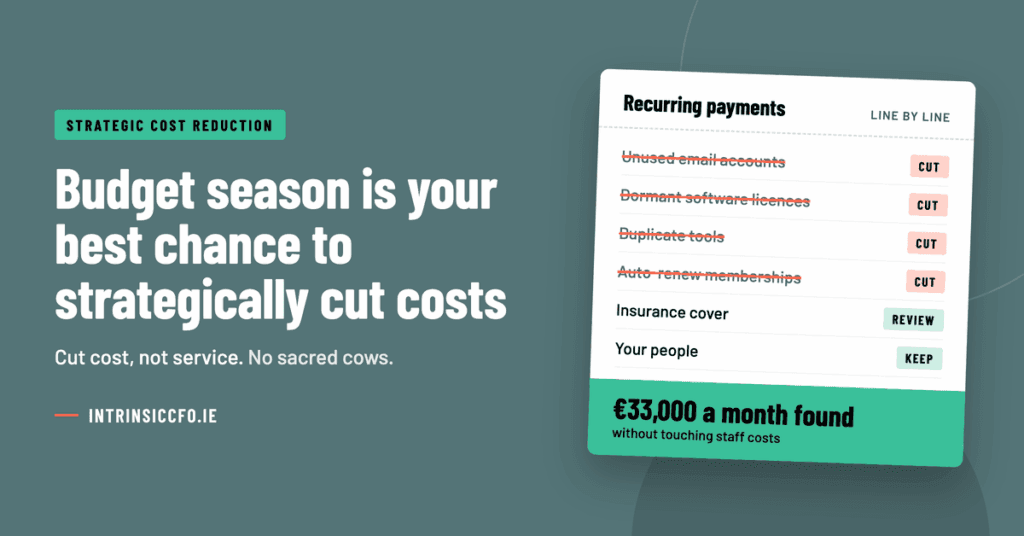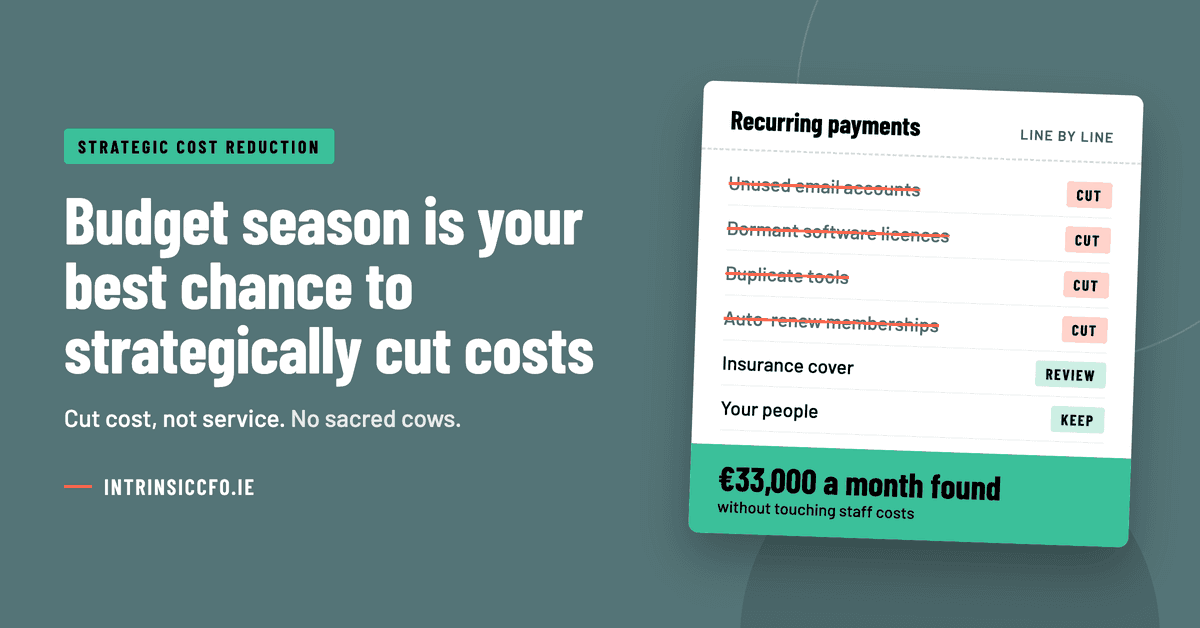
I once worked with a startup of around 50 staff that was losing €100,000 a month. When we went through its costs line by line, we found €33,000 a month in savings without touching a single salary. Most of it was small, everyday waste hiding in plain sight.
In my last post, I argued that every expense in your budget should be justified from scratch. That’s zero-based budgeting, and it’s the best defence against carrying last year’s waste into next year.
But there’s a bonus that many owners miss. If you’re already going through every cost line to build the budget, you’ve done most of the work of a strategic cost review. Budget season is the one time of year when you have the data in front of you, the time set aside, and a clear reason to ask hard questions.
I’ve delivered cost reduction projects for a large financial services company, a university and a startup, and worked with more than 30 SMEs as a fractional CFO. The lesson is the same everywhere: the pennies add up to the pounds. Here’s how to find them, without cutting the things that matter.
Start with one question: do we need it at all?
Before you negotiate a better price on anything, ask whether you need it in the first place. It’s the simplest question in cost reduction, and it delivers the fastest savings.
Software subscriptions are the classic example. A business might be paying for 40 licences when only 10 people use the tool. Or it might be paying for a tool that another subscription it already owns can do just as well. In both cases, the saving comes from cutting, not negotiating.
The same question applies to spend policies. Printing is a good example. If your business still prints, look at what, how much and why. There can be a surprising amount of waste in something nobody thinks about.
But “do we need it?” also means “is it fit for purpose?” Insurance is where this matters most. A good broker will review your policies to check they actually match your risks. Sometimes the premium goes up as a result, and that’s the right outcome. Being under-covered is the real waste, because you only find out when something goes wrong.
Case study: when the pennies became €33,000 a month
I worked with a startup of around 50 staff that was running a shortfall of €100,000 a month. When we went through the costs line by line, the waste was everywhere, and most of it was small.
- Email accounts nobody used. Each of the 25 to 30 staff on the factory floor had a paid company email account. They didn’t have time to read emails and didn’t need them for their work. One shared address would have been enough.
- The magpie effect. The business was constantly attracted to the next shiny piece of software, without checking whether its existing tools could already do the job. Almost every time, they could.
- Duplicate tools. Microsoft Office and Slack were both running for around 50 staff.
- Dormant licences across all the software, for people who didn’t need or use them.
- Memberships on auto-renew that nobody tracked or needed.
- Nothing benchmarked. Insurance, energy, utilities, telecoms and banking fees hadn’t been reviewed in years. Nobody had gone to market to test whether they were getting value for money.
The review identified €33,000 a month in operating cost savings. That was without touching staff costs or annual costs. On top of that, we identified €150,000 from selling off slow-moving stock sitting on the balance sheet.
There was a knock-on lesson too. Because supplier payments weren’t processed on time, key supplies arrived late, which delayed production and, in turn, customer orders. Poor cost control and poor cash control are often the same problem.
Strategic, not slash and burn: no sacred cows
The idea behind strategic cost reduction is simple. You cut cost without sacrificing the service. That’s what separates it from slash-and-burn cutting, which saves money today and damages the business tomorrow.
But being strategic also means being honest. There can be no sacred cows.
Shortly after the 2008 crash, I was delivering a cost reduction project for a large financial services company. My brief was to identify savings without prejudice. One obvious candidate was the company’s sponsorship of a well-known arts venue. It wasn’t a popular suggestion with one executive, who clearly enjoyed the events and the corporate hospitality that came with it.
Every business has costs like that: the ones someone senior is attached to. Often, that someone is the owner. Those costs deserve the same question as everything else: does this deliver value for the business, or just for the people who enjoy it?
Then go to market with confidence
Once you’ve confirmed what you need and why, you’re in a strong position. You know exactly what you’re buying, so you can go out to market and compare like with like.
This is where procurement skills make the difference. The aim isn’t to get the cheapest price. It’s to get better value for money for the same service. Insurance, energy, utilities, telecoms and banking fees are the obvious places to start, because they’re so often renewed on autopilot.
You can also use your budget to plan ahead for savings. Once you’re happy with a supplier, set money aside so you can:
- Take early payment discounts where suppliers offer them
- Pay annual bills upfront when that’s cheaper than paying monthly
In my last post, I described a client who ring-fenced cash for VAT, corporation tax and annual insurance. The same principle works here. A little planning in the budget turns a discount from a nice idea into money in the bank.
Make the savings stick
Finding savings is the easy part. Keeping them is harder. Without controls, the magpie comes back, the auto-renewals creep in, and within a year you’re back where you started.
Three controls make the biggest difference.
Give every spend category an owner. At the startup, we recommended that one IT manager take charge of all software spend, with every new purchase needing their approval. Their job was to know every paid tool, what it was for, how many licences there were, who had one and why. They’d also spot duplicates, like paying for both Outlook and Gmail, or Teams and Zoom.
Set approval limits by value. On a cost reduction project at a university, we introduced a spend authorisation policy. The bigger the purchase, the more senior the person who had to approve it. Small purchases stay quick, while big ones get proper scrutiny.
Use purchase orders. If nothing gets paid without a purchase order, your accounts payable team has a natural checkpoint before money leaves the business.
Then track it. Your monthly budget-versus-actual review is the perfect place to confirm the savings are actually landing, and to spot any costs creeping back.
Cutting staff first is usually the easy option
When cash gets tight, many owners reach for headcount first. I think that’s usually a mistake.
At the startup, we found €33,000 a month without touching staff costs at all. Most businesses have plenty of waste in subscriptions, suppliers and contracts before they ever need to look at people. And in most small businesses, your people are the service. Cut them first and you break the one rule of strategic cost reduction: cut cost, not service.
If you do one thing this budget season
Pull a list of every recurring payment.
Export twelve months of bank and card transactions. List every subscription, contract, membership and direct debit. Then ask the zero-based question of each one: do we still need this, and is it fit for purpose? It takes a few hours, it needs no procurement expertise, and it almost always finds money.
One last story. Years ago, I was involved in delivering over 20 cost reduction workshops. The final slide was meant to read: “Spend every penny as if it’s your last.” Somehow, an edited version ended up in one of the workshop presentations. It read simply: “Spend every penny.” It got a nervous laugh from the room but joking aside in a cash crash “spend every penny as if it’s your last”.
The message matters, and so does making sure the whole sentence makes it onto the slide.
Want a fresh set of eyes on your costs?
If you’re building your budget for the year ahead, I have some capacity to help small business owners review their costs at the same time.
An outside eye helps. I’ll ask the questions nobody inside the business wants to ask, name the sacred cows, and use my procurement experience to get you better value for money without cutting the service your customers rely on.
If that sounds useful, get in touch through intrinsiccfo.ie to book a free first call.