Every autumn, small business owners start thinking about the year ahead, and many bring in a CFO to build the budget. That’s a smart move. But a budget built by a CFO alone is only half a budget.
I’ve worked in finance since 2001: as a management accountant, in finance transformation at PwC and Deloitte, and as a fractional CFO for more than 30 businesses in Ireland and Canada. The same pattern shows up repeatedly. The quality of a budget depends far less on the spreadsheet/ accounting system than on the thinking the owner brings to it.
Your CFO’s job is to build the budget and then challenge it hard. Your job is to make sure your insight can stand up to that challenge. Here’s what that looks like in practice.
Where owners usually go wrong
When owners come to the budget table, four problems tend to come up more than any others.
- Assumptions that haven’t been thought through. “Sales will be up a bit” is not an assumption. Which customers, which products, at what price, starting when? Every number in a budget rests on an assumption. If the assumption is vague, the number is a guess.
- Defaulting to incremental budgeting. The easy approach is to take last year’s figures and add a few percent. The problem is that last year’s waste gets carried forward too. With zero-based budgeting, every expense must be justified from scratch. Do we still need that subscription? Is that contract still good value? It takes more effort, but it’s the only way to know your cost base is right.
- Rounding from the start. Rounding a rent figure here or a wage cost there feels harmless. But small rounding errors compound across twelve months and dozens of lines. By mid-year, you’re investigating variances that only exist because the budget was imprecise on day one.
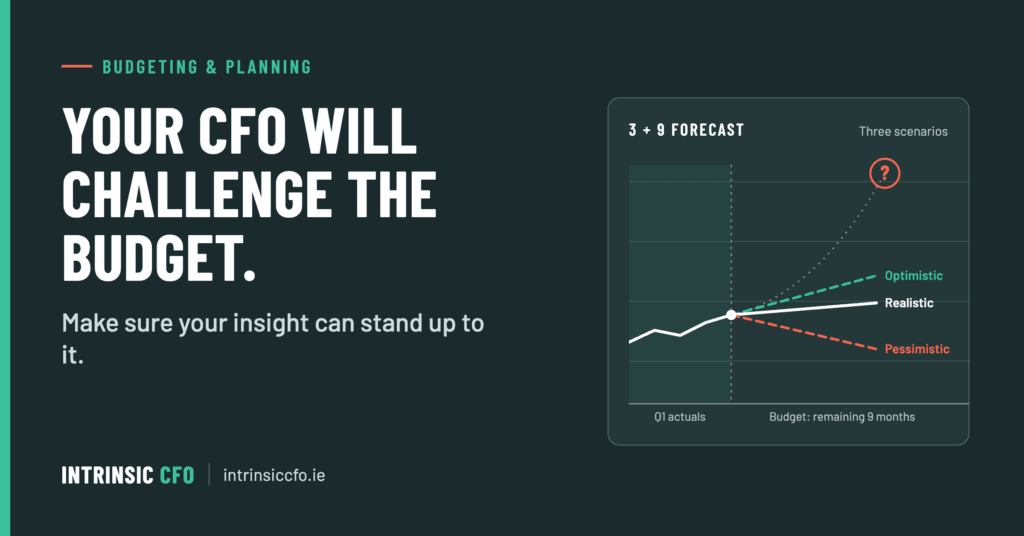
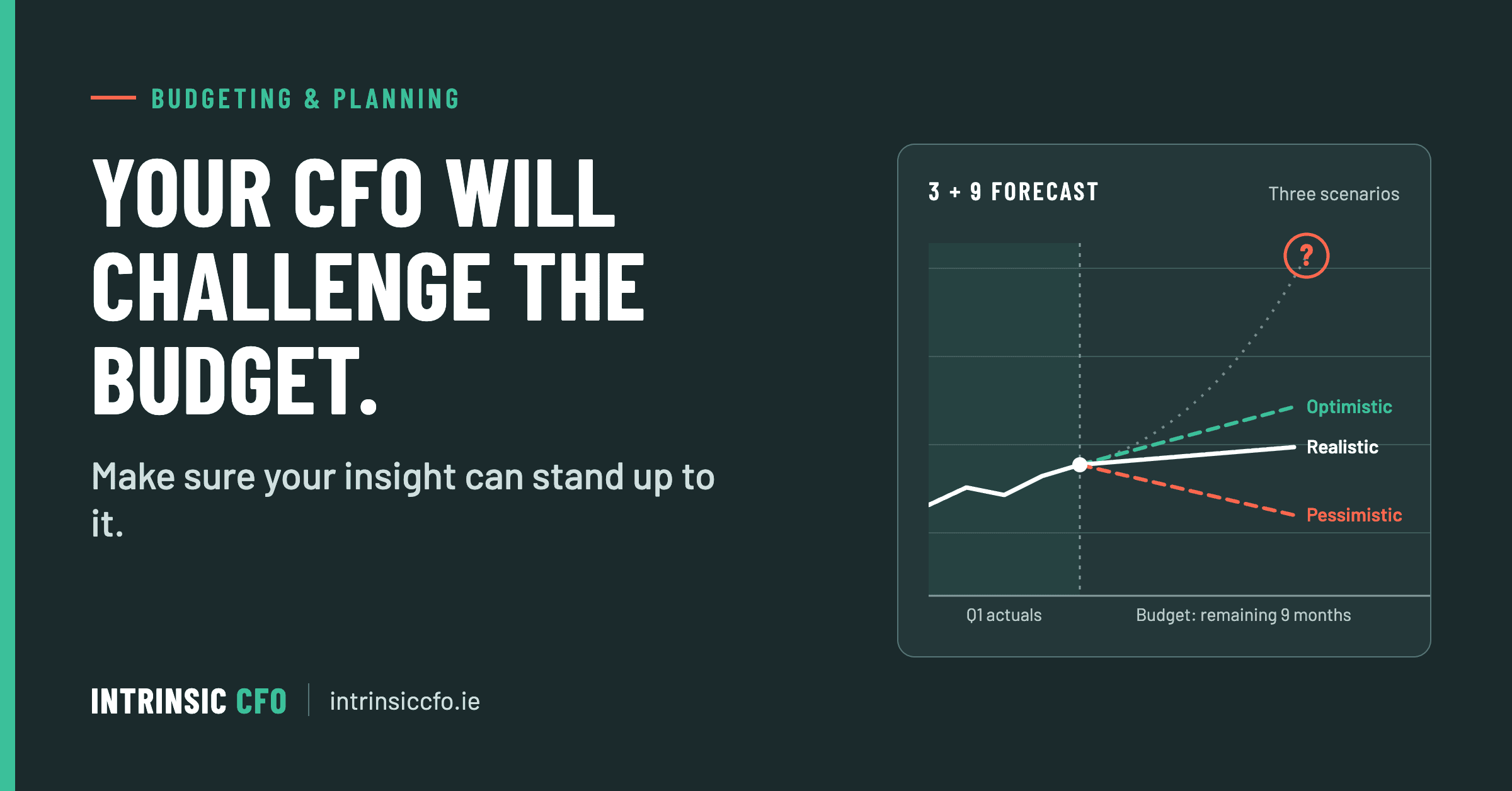
- Planning for only one outcome. Most owners build one version of the year. I always want to see three: an optimistic case, a pessimistic case, and a realistic case in the middle. If sales drop 20%, what happens to your cash? You want to know the answer in October, not discover it in June.
Your job: own the assumptions. Your CFO’s job: challenge them.
Nobody knows your business like you do. You know which customers are likely to grow, which are at risk, what you’re planning to launch, and who you need to hire. That knowledge is the raw material of a good budget, and no CFO can replace it.
So, the most useful thing you can do is give your CFO assumptions in as much detail as possible:
- Sales by customer, product or service line, with pricing and timing
- Planned hires, pay increases and when they kick in
- Major purchases, contracts up for renewal and any new premises or equipment
- Your plans for growth, and what must happen for them to work
Your CFO’s job is to bring all of that together into a budget for the year ahead. Then comes the part many owners don’t expect: stepping back and challenging it.
When I build a budget, I run a trend analysis against past performance to spot anything that looks out of line. If a cost line suddenly drops or a revenue stream jumps, I’ll ask why. I check it against what I know from inside the business. I also benchmark the projected gross and net profit margins against industry norms. If your plan shows margins well above what similar businesses achieve, there needs to be a good reason.
This isn’t about second-guessing you. It’s about making sure the budget will stand up to scrutiny from your bank, your investors and, most importantly, the reality of the year ahead.
Case study: from no budget to a €300k safety net
One client came to me with no plan, no budget and no forecast. Cash was managed reactively, and tax payments put real pressure on cash flow.
We built a zero-based budget for the year ahead, with every expense measured and justified. Two numbers came out of that work that changed how the owner ran the business:
- A monthly operating cost target of €100k. The owner now knew exactly what it cost to keep the doors open.
- A minimum cash balance of €300k. That’s three months of operating costs, held in the bank at all times.
We then set aside cash in separate savings accounts for VAT, corporation tax and the annual insurance premium. Paying insurance upfront earned a discount instead of paying extra for monthly instalments. With tax money already ring-fenced, the business no longer needed expensive short-term financing when payments fell due.
The owner put the advice into practice straight away. The pressure lifted almost immediately. Cash flow became something to manage, not something to fear.
The lesson is that a budget isn’t just a profit and loss exercise. Done properly, it tells you how much cash you need, when you need it, and how to stop it surprising you.
During the year: review monthly, reforecast after Q1
A budget that sits in a drawer is wasted effort. Once it’s signed off, the real value comes from reviewing it every month.
Each month, actual results should be compared against the budget. Any large variance, good or bad, should be investigated and clearly explained to the owner. A favourable variance deserves as much attention as an unfavourable one. It might be a genuine win, or it might be a timing difference that will reverse next month. If corrective action is needed, agree it at the review meeting, with a clear owner and timeline.
Reforecasting matters too, but don’t do it too early. I usually wait until the end of Q1, because that’s when the trends for the year start to emerge.
Here’s an example. One client had an unexpected spike in sales in Q1. Before changing anything, we sat down to understand why it happened. It turned out to be a one-off. So, we built a ‘3+9’ forecast: three months of actual results plus the original budget for the remaining nine months. The forecast reflected the good quarter without assuming it would repeat.
That gave the owner three clear reference points for projected year-end performance:
- Prior year: are we growing?
- Budget: are we on track for the original goal?
- Forecast: where do we realistically expect to land?
Together, those three numbers tell a far richer story than any one of them alone.
Leave the hockey stick at home
I’ll be blunt: hockey-stick growth projections irritate me. Who actually believes them in the first place?
They look great in a board pack, but in practice they do damage. If your team starts the year behind an unrealistic target, they stay behind it all year. Instead of learning anything useful about performance, everyone spends their time and energy explaining why they missed a number that was never achievable. That’s demotivating, and it buries the real insights.
The same goes for rounding. Imprecise budgets create compounding variances, and then everyone wastes the year analysing differences that mean nothing. A realistic, precise budget is far more useful than an ambitious, sloppy one.
If you do one thing differently this year
Spend more time on your assumptions, not less.
Take yourself away from the office to an offsite location if you can and give the budget your full attention for one to three days. Get into the weeds. Look at the data. Question every line. Build a budget that will stand up to scrutiny.
The payoff comes all year long. When the budget is solid, your monthly reviews become genuinely insightful. The variances that show up will come from events nobody could have foreseen, and they’ll be much easier to spot and act on.
Want a fresh set of eyes on your plan?
If you’re starting to think about the year ahead, I have some capacity to help small business owners with their budgeting and planning process.
Sometimes the most valuable thing a CFO brings is a fresh set of eyes. Someone to challenge your assumptions, test your numbers against your own track record and your industry, and help you build a budget you can actually rely on.
If that sounds useful, get in touch through hello@intrinsiccfo.com to book a free first call.