There’s a moment I see again and again in growing businesses. Sales are up. The team is bigger. The bank balance looks healthier than it did three years ago. And yet the owner sits across the table from me and admits something uncomfortable: “We’ve grown, but I don’t really know why.”
That isn’t a failure. It’s a sign the business has outgrown the way its numbers are run. It’s also the point where a fractional CFO can make the biggest difference: helping you understand the growth you already have, so you can build on it rather than stumble into the next stage.
Why I do this work
I’ve spent more than two decades in finance, and I’ve seen it from almost every angle.
I started as a management accountant, spending seven years inside businesses producing the numbers that owners and boards relied on. I then spent seven and a half years in Big 4 consulting, at PwC and then Deloitte, working in finance function effectiveness and finance transformation roles. That taught me what good looks like, and how to get a finance function from where it is to where it needs to be.
In 2016 I went out on my own as a fractional CFO in Canada, because I had always wanted to be self-employed. When I came back to Ireland, I co-founded a procurement SaaS startup. It didn’t work out. That experience was humbling, and valuable. I now know from the inside what it’s like to be the founder making hard calls with imperfect information, and I bring that empathy to every client.
Since 2022 I’ve worked as a fractional CFO in Ireland. I love the variety and the autonomy, and I love seeing a business owner go from anxious about their numbers to confident in them.
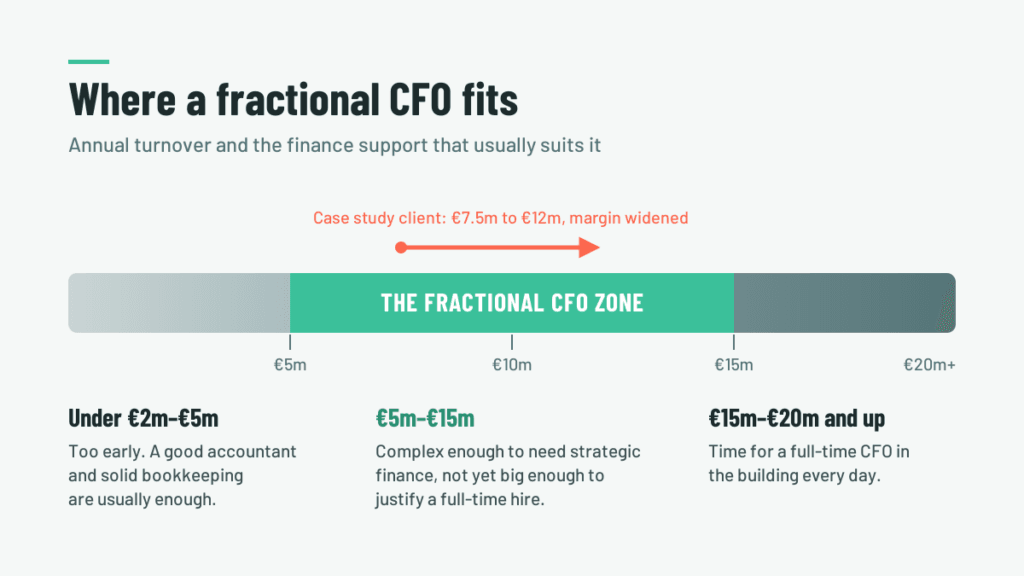
The sweet spot: roughly €5m to €15m in turnover
A fractional CFO isn’t right for every business, and I’d rather tell you that up front.
• Below €2m to €5m in turnover: it’s usually too early. A good accountant and solid bookkeeping are generally enough at this stage.
• €5m to €15m: this is the fractional CFO zone. The business is complex enough to need strategic finance, but not yet big enough to justify a full-time hire.
• €15m to €20m and above: it’s time for a full-time CFO. The business needs, and usually wants, someone in the building every day.
The middle band is where businesses are most exposed, and it’s the scaling phase where a fractional CFO is the specific solution. They’ve outgrown “the accountant does the year end”, but a €100,000+ finance director isn’t yet justified. That gap is exactly what a fractional CFO fills.
Signs you’re ready for a fractional CFO
The owners who call me tend to share a few things in common:
• You’ve grown, but you can’t explain why. Revenue is up, but you couldn’t say with confidence which products, customers or channels drove it, or which ones lose you money.
• You’re not on top of your figures. Management accounts arrive late, or not at all, and decisions are made on gut feel and the bank balance.
• You can feel an opportunity in front of you, and you don’t want to waste it. A new market, a big contract, an acquisition, a new site. You know this is the moment, and you want to get it right.
• You want an outside expert, not another employee. You value someone who has seen dozens of businesses, who will challenge you, and who can help transform the business rather than just report on it.
If two or more of that sound familiar, it’s worth a conversation.
Case study: from €7.5m to €12m without losing margin
From November 2022 to early 2026, I worked as fractional CFO for a business in the tourism area. When I started, turnover was around €7.5m. By the time we finished, it was €12m.
That growth alone would be a good story. What makes it unusual is what happened to the margin. Most businesses that grow by 60% in a little over three years lose margin along the way. Costs creep up, discounts get given to win volume, and overheads grow faster than anyone notices. Here, the opposite happened: margin widened, and operating expenses were tightly managed throughout.
What we did: [we set a zero-based budget for the year ahead, meaning every expense had to be justified, throughout the year we produce forecasts to put better performance information in front of the owner and we challenged the sales director to maintain gross profit margins in all transactions and avoid discounts.
The lesson for any scaling business is simple. Growth and profitability aren’t a trade-off if you can see clearly what’s driving each one.
One of the most expensive mistakes I see: impatient funding
If I could change one habit in growing businesses, it would be how they look for funding.
Small business owners can be impulsive and impatient about finance. They need money, they ask the bank, and the bank is slow to come back. So, they turn to alternative lenders, who say yes quickly, at much higher interest rates. That impatience can be very expensive over the life of a loan.
Good cash flow planning fixes this in two ways:
1. It can remove the need to borrow at all. When you can see your cash position months ahead, you often find you can fund growth from the business itself by managing timing, stock and debtors. E.g. paying annual insurance upfront saved €2,000 versus financing over the year.
2. It gets you to the bank sooner. If you know you’ll need funding in six months, you can start the process now. The bank can be as slow as it likes; you’ll still have the money when you need it, at a far lower rate.
Banks are slow. That’s not going to change. What you can change is when you knock on their door.
What working with a fractional CFO looks like
It depends on the size of the business and what’s happening in it at the time. As a guide:
• A typical month is 2 to 3 days, assuming your books are clean and up to date.
• A busy month can be 7 or 8 days. Raising funding is the most common reason, because preparing forecasts, business cases and bank packs takes focused time.
That flexibility is the point. You get senior finance input when you need it, and you don’t pay for it when you don’t.
The first 90 days
The first three months are about working out together where I can add the most value. That means getting to know the business properly: not just the numbers, but the systems, processes and people behind them. Only then can we agree priorities that make a real difference, rather than producing reports for the sake of it.
What it costs
A fractional CFO typically costs around €40,000 a year. A full-time CFO costs about €100,000 in gross salary, before you add pension, benefits, employer PRSI and the cost of recruiting.
That’s less than half the cost for a business that probably doesn’t need a CFO five days a week yet. And you’re getting someone who has seen the same challenges in many businesses, not just yours.
Your next step
If you’ve grown and you’re not sure why, or you can see a big opportunity and don’t want to waste it, let’s talk. A short, no-obligation conversation is usually enough to tell whether a fractional CFO is right for you now, later, or not at all.
If you would like to connect or collaborate, send an email to hello@intrinsiccfo.com.